If you want to build a career working with metal — welding structures together or repairing vehicle bodies — the Niagara region is a practical place to train. This guide covers your main options for learning welding and auto body locally, how the apprenticeship route works alongside college, and how to choose the path that fits you.
A note up front: program offerings, intakes, and tuition change every year, so confirm current details directly with each institution and with Skilled Trades Ontario before you commit.
Two routes into these trades
There are really two ways in, and they often combine:
- College training gives you hands-on shop hours, theory, and credentials before (or alongside) employment. It’s the smoother on-ramp if you don’t yet have an employer.
- Apprenticeship is paid on-the-job training with a sponsoring employer, supplemented by in-school sessions. It’s how you ultimately get certified.
The strongest approach for many people is to do some college training first to build skills and make yourself hireable, then move into a registered apprenticeship.
Welding at Niagara College
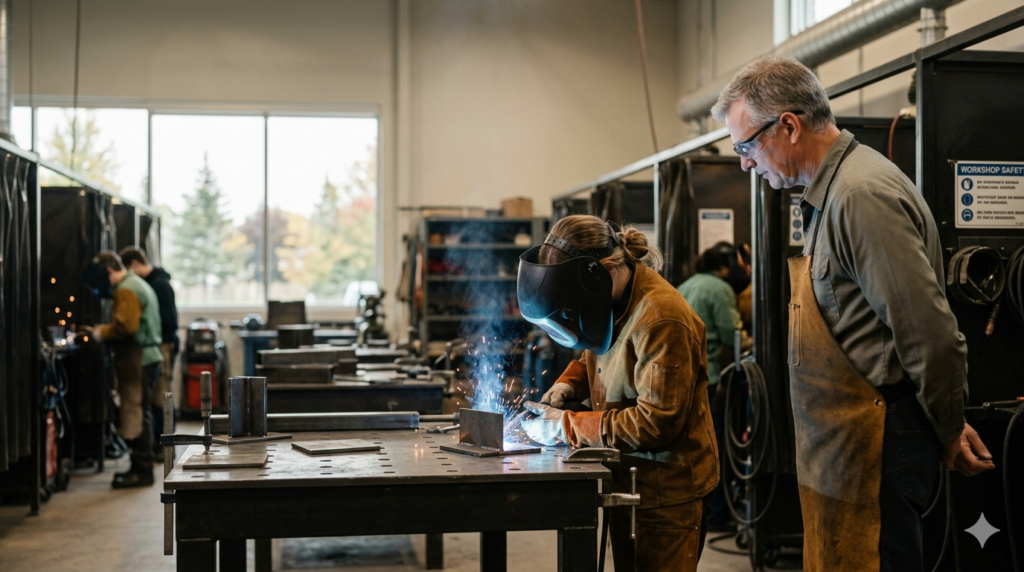
The most prominent local option is Niagara College’s School of Trades, based at the Welland Campus (in the Rankin Technology Centre). It offers welding programs — including a one-year Welding Techniques certificate — with hands-on learning in a full-size weld shop and fabrication lab. A standout detail: the facility is an accredited Canadian Welding Bureau (CWB) and Technical Standards & Safety Authority (TSSA) test centre, which matters because those are exactly the tickets employers look for. Niagara College also delivers the in-school portion of the Welder apprenticeship (the roughly 720 hours of classroom training that accompany the on-the-job hours) and runs CWB welder testing days.
Tuition varies significantly between domestic and international students, and for apprenticeship in-school training the majority of tuition is covered by the province — so confirm your specific situation with the college.
Auto body and automotive
Niagara College’s School of Trades also covers the automotive side, with paths toward working as an automotive service technician or running your own shop. For auto body / collision repair specifically, options can be more limited locally and change over time, so it’s worth checking the college’s current program list directly, and also considering the apprenticeship route — finding a collision or body shop willing to sponsor you. Other Ontario colleges offer dedicated auto body and collision programs if a local option isn’t available in the intake you need.
If you already work at or near a dealership or repair shop, that existing connection can be a real advantage in landing a sponsor.
The apprenticeship path in brief
To become certified through an apprenticeship in Ontario, the general path (administered by Skilled Trades Ontario) is:
- Build basic skills, ideally through a college or pre-apprenticeship program.
- Find an employer willing to sponsor you.
- Register your training agreement.
- Complete your on-the-job hours plus the required in-school training.
- Pass the certifying exam for your trade.
Welder is a non-compulsory trade (you can work without certification, but tickets unlock better pay and some jobs require them, such as pressure work via TSSA). Automotive service technician is a compulsory trade, so certification is required to practise independently.
How to choose your path
Ask yourself a few questions:
- Do you have an employer lined up? If yes, the apprenticeship route can start now. If no, college first makes you far more hireable.
- Which tickets does your target job require? For welding, CWB and possibly TSSA tickets; the right program builds toward these.
- What’s your timeline and budget? A one-year certificate is faster; a full apprenticeship takes a few years but pays you throughout.
The bottom line
In the Niagara region, Niagara College’s Welland campus is the central place to train in welding, with CWB- and TSSA-accredited facilities and both certificate programs and apprenticeship in-school training. Automotive service training is also offered locally; for auto body/collision specifically, check current local offerings and consider finding a sponsor shop. Whichever trade you choose, the smart play is to build skills and tickets first, then lock in a registered apprenticeship to get certified.
Program details reflect information available in 2026 (sources include Niagara College’s School of Trades pages and Skilled Trades Ontario). Programs, intakes, tuition, and requirements change every year — confirm current details with Niagara College and Skilled Trades Ontario before enrolling.
Leave a Reply