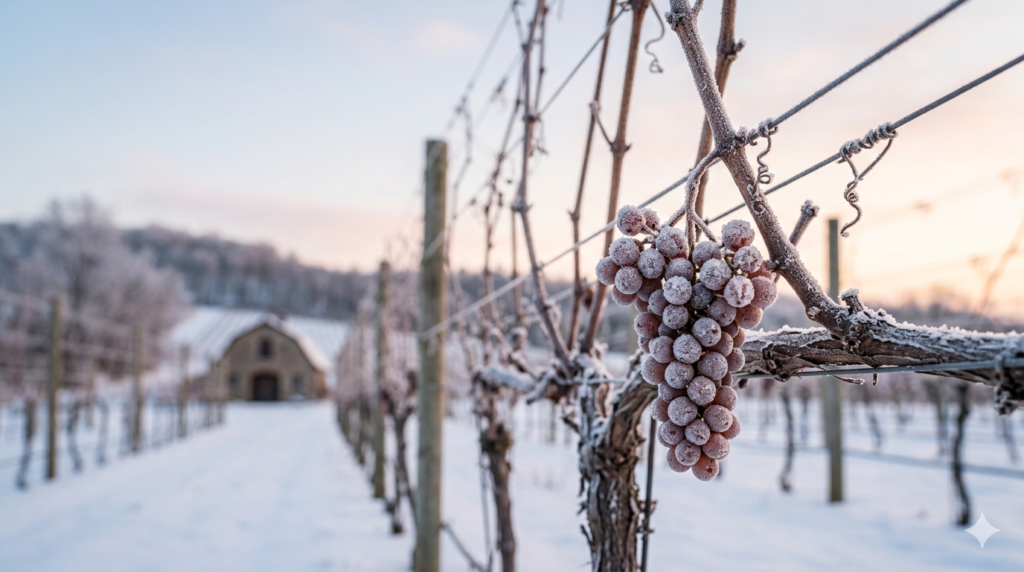
Niagara is the largest producer of icewine in the world, and there’s no better place to experience this uniquely Canadian dessert wine than where it’s made. If you’ve never tried it — or never understood what makes it special — this guide covers what icewine is, how it’s made, when the season happens, and how to taste it like you know what you’re doing.
A quick note: festival dates and winery hours change every year, so confirm the current schedule before planning a visit.
What icewine actually is
Icewine is a sweet, intensely concentrated wine made from grapes that freeze naturally on the vine. The story goes back to a happy accident in late-1700s Germany, when an early frost hit the vineyards and growers pressed the frozen grapes anyway — yielding something surprisingly delicious. Today, growers deliberately leave designated grapes on the vine well past the normal harvest, waiting for deep cold.
The result is a wine with remarkable sweetness balanced by bright natural acidity — the combination that defines Niagara’s signature style. It’s typically served chilled in small pours, as a dessert wine or paired with food.
How it’s made (and why it’s so hard)
Here’s the detail that makes icewine special: in Ontario, production is regulated by the VQA (Vintners Quality Alliance), and the grapes must be naturally frozen and harvested at a temperature of −8°C or colder. Picking and pressing happen in a continuous process while it’s that cold — often in the middle of a winter night. Because the frozen water stays behind as ice during pressing, only a tiny amount of intensely concentrated juice is extracted, which is why icewine is produced in small quantities and priced accordingly.
The grapes that thrive for it in Niagara’s climate include Vidal, Riesling, Cabernet Franc, and Cabernet Sauvignon — Niagara’s cold winters and warm summers make it one of the few regions on earth that can reliably produce high-quality icewine.
When the season happens
The harvest itself depends on the weather hitting −8°C, typically in the heart of winter. But the celebration peaks in January, when the Niagara Icewine Festival (part of the Niagara Grape & Wine Festival’s Icewine Series) takes over wine country. In 2026, the festivities ran across mid-to-late January, including a self-guided Icewine Discovery Pass for winery pairings, the Icewine Village on Niagara-on-the-Lake’s Queen Street over two weekends, and a signature evening gala at the Niagara Parks Power Station. Dates shift annually, so check the current calendar.
Where and how to taste it
You have a few good options:
- The Icewine Festival passes: the easiest way to sample widely, with self-guided icewine-and-food pairings across participating wineries.
- The Icewine Village (NOTL): Queen Street transforms into a winter gathering with tastings, culinary creations, ice sculptures, and fire pits — often with free general admission and paid VIP upgrades.
- Winery tasting rooms: many Niagara wineries — including well-known names like Inniskillin, Peller Estates, Reif, and Trius — offer icewine tastings and experiences year-round, with some featuring novelty spaces like ice lounges.
Tasting tips for beginners
- Serve it cold and small. Icewine is meant for small pours; a little goes a long way given the sweetness and price.
- Pair it well. It shines with dessert, strong or blue cheeses, foie gras, or simply on its own after dinner.
- Taste before you buy. Styles vary by grape — Vidal tends to be rich and tropical, Riesling more citrusy and structured, the reds more berry-forward.
- Mind the price. Because yields are tiny, icewine costs more than table wine and usually comes in smaller (375 ml or 200 ml) bottles. That’s normal.
A note on bringing it home (and across the border)
Icewine makes a popular gift and souvenir. If you’re crossing back into the U.S. or returning to Canada with bottles, remember that alcohol falls under specific customs allowances and can’t always be included in your basic duty-free exemption — check the current limits before you load up the car.
The bottom line
Niagara icewine is a genuine local treasure: a sweet, concentrated wine made from grapes frozen on the vine at −8°C, regulated by the VQA, and celebrated each January with a festival centered on Niagara-on-the-Lake. The easiest way in is a festival pass or a visit to a tasting room — serve it cold, in small pours, and pair it with something rich.
Details reflect information available for 2026 from regional tourism, winery, and VQA-related sources. Festival dates, winery hours, and customs allowances change — confirm current details before planning a visit or bringing bottles across the border.
Leave a Reply