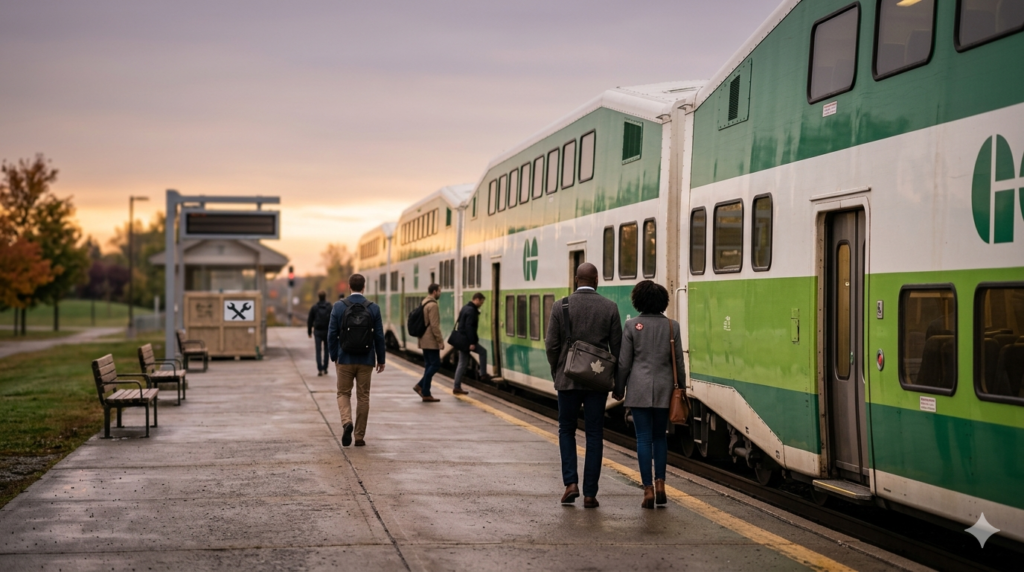
A big reason people move to Niagara is simple math: housing costs far less here than in Toronto. But if your job is still in the GTA, the commute is the catch. Here’s an honest look at your options — the GO train, the QEW, and what the trip actually involves in 2026.
A quick note: transit schedules and road conditions change. Confirm current GO schedules and live traffic before you plan your routine.
The big development: year-round GO train service
For most of history, you couldn’t take a regular weekday commuter train from Niagara to Toronto — you’d drive to Burlington and transfer to a bus. That changed. GO Transit now runs year-round weekday train service on the Lakeshore West line connecting Niagara Falls and St. Catharines to Toronto, with a stop at Hamilton’s West Harbour station along the way.
In practical terms, a morning train departs Niagara Falls very early (around 5:19–5:24 a.m.), stops in St. Catharines (around 5:41 a.m.), and continues to Union Station; an evening train leaves Union (around 5:15 p.m.) for the return. There’s also expanded weekend service, popular with day-trippers heading into the city or out to the Falls. Kids 12 and under ride free, and you’ll want a PRESTO card.
The honest catch: frequency
Here’s the part to plan around. The weekday train service is still limited — essentially built around one main commuter round trip, not the all-day frequency a Toronto subway rider expects. Commuters have pointed out that if you miss the morning train from St. Catharines, your next realistic option may be driving to Burlington to catch a train there. So the GO train is a genuine game-changer for a standard 9-to-5 in downtown Toronto, but it’s less flexible if your hours vary or run late. Always build a backup plan.
(Service can also be disrupted occasionally — a freight-train derailment near St. Catharines in spring 2026 briefly suspended trains before service resumed — so it’s worth following GO/Metrolinx alerts.)
Driving: the QEW
The alternative is driving the Queen Elizabeth Way (QEW), the main highway linking Niagara to Hamilton, Burlington, and the GTA. Realistically, the drive from Niagara to Toronto runs roughly 1.5 to 2 hours in good conditions, but rush-hour and weather can stretch it well beyond that. Factor in fuel, wear on the car, parking in Toronto (expensive), and the mental toll of a long daily drive. For many, driving makes sense only if the train times don’t fit their schedule.
Which works for you?
- Standard downtown-Toronto hours? The GO train is likely your best bet — you can work or rest instead of driving, and you skip Toronto parking costs.
- Variable hours, late nights, or a non-downtown destination? Driving the QEW may be unavoidable, at least part of the time. A hybrid (train some days, drive others) is common.
- Hamilton or the western GTA, not downtown Toronto? Your commute is much shorter, and either option is more manageable.
A smarter middle ground
Many Niagara residents who work in the GTA don’t commute daily five days a week. Hybrid and remote work have made it realistic to go in two or three days and work the rest from home — which turns a brutal daily commute into a tolerable few-times-a-week trip, while keeping Niagara’s lower housing costs. If your job allows it, that’s often the sweet spot.
The bottom line
Commuting from Niagara to Toronto is more viable than it used to be, thanks to year-round weekday GO train service from Niagara Falls and St. Catharines — but the frequency is still limited, so it fits a standard schedule better than an irregular one. Driving the QEW is the flexible fallback at roughly 1.5–2 hours each way. For most, the realistic win is a hybrid schedule that limits how often you make the trip at all.
Details reflect GO Transit service and conditions available in 2026 (sources include Metrolinx/GO Transit and regional reporting). Schedules and service change — confirm current GO schedules and live traffic before planning your commute.
Leave a Reply